MoPH Introduces Five-Year National Health Strategy to Strengthen Afghanistan’s Health System
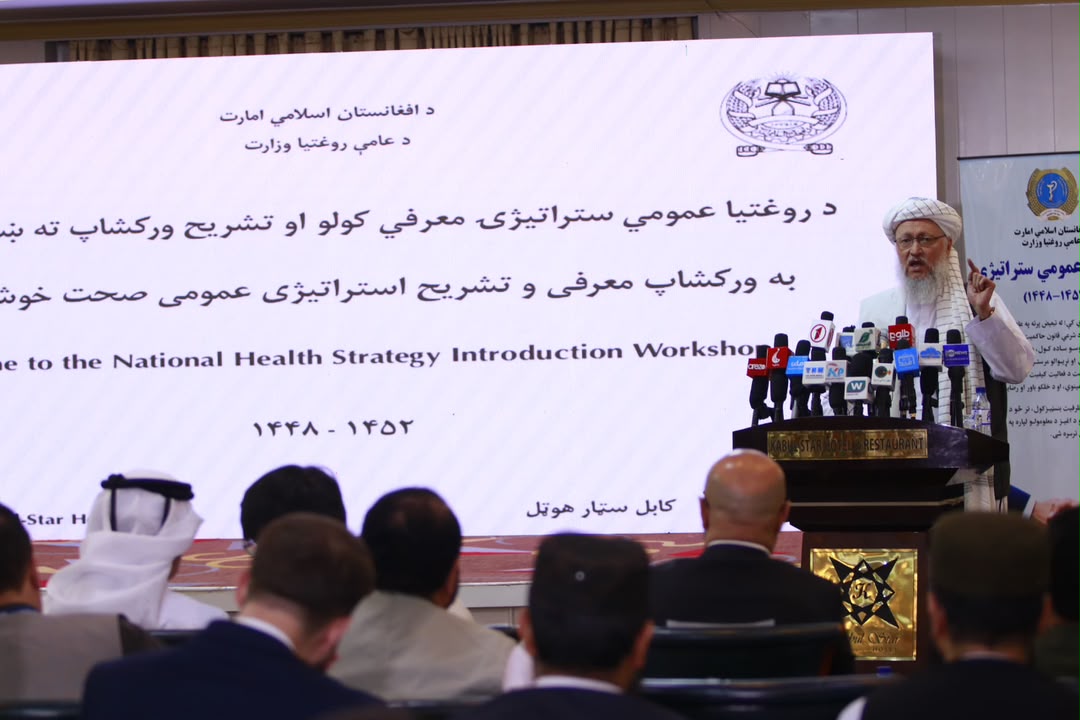
The Ministry of Public Health of the IEA held a meeting to introduce and explain the five-year National Health Strategy, which aims to strengthen, reform, and further develop the country’s health system.
The meeting was attended by Mawlawi Abdul Salam Hanafi, Deputy Prime Minister for Administrative Affairs of the IEA; Mawlawi Noor Jalal Jalali, Minister of Public Health; deputy ministers and directors general of the Ministry of Public Health; Dr. Abdul Latif Nazari, Deputy Minister for Technical Affairs Ministry of Industry and Commerce; officials and representatives of the Ministries of Education, Higher Education, Finance, and Agriculture, Irrigation and Livestock, as well as the Kabul Municipality; along with representatives of embassies, international health organizations, and the media.
H.E Mawlawi Abdul Salam Hanafi, said that the IE is committed to strengthening the capacity of healthcare workers, improving hospital infrastructure and equipment, and implementing long-term development plans. He added that Afghanistan’s health sector still requires further development and that significant progress has already been made in this area.
H.E Mawlawi Noor Jalal Jalali, described the strategy as a significant step toward reforming and further developing the country’s health system. He said that its implementation would expand access to healthcare services, improve the quality of care, and strengthen health infrastructure and human resources.
The Minister further emphasized that implementing the strategy would contribute to strengthening the country’s health system and enable it to better address the healthcare needs of the population. He added that it would also help ensure more equitable and broader access to quality healthcare services.
Dr. Mohammad Hassan Ghiyasi, Deputy Minister for Health Development and Policy, outlined the seven key areas of the National Health Strategy and emphasized their importance in improving the country’s overall health outcomes. He described the strategy as more than just a theoretical framework, calling it a practical and action oriented strategy that will improve the quality of healthcare services and expand access to them through clear objectives, targeted activities, and concrete actions.
H.E Dr. Abdul Latif Nazari, said that the National Health Strategy is a significant step toward reducing maternal and child mortality and strengthening the health sector. He added that its implementation would lead to substantial improvements in the quality of healthcare services.
Furthermore, Dr. Sayed Rasool Mangal, Director General of Planning and Policy of the MoPH, said that the National Health Strategy was developed in line with scientific and technical principles and based on the country’s healthcare needs and priorities. He noted that the strategy covers seven key areas and will support the implementation of practical measures to strengthen health infrastructure, equip hospitals, expand preventive and curative healthcare services, increase vaccination coverage, and enhance the capacity of healthcare workers.
Furthermore, Dr. Edwin Ceniza Salvador, WHO Representative in Afghanistan, described the five-year National Health Strategy as an important initiative and emphasized its significance in strengthening Afghanistan’s health system and further improving the delivery of healthcare services.
