Medical Director!
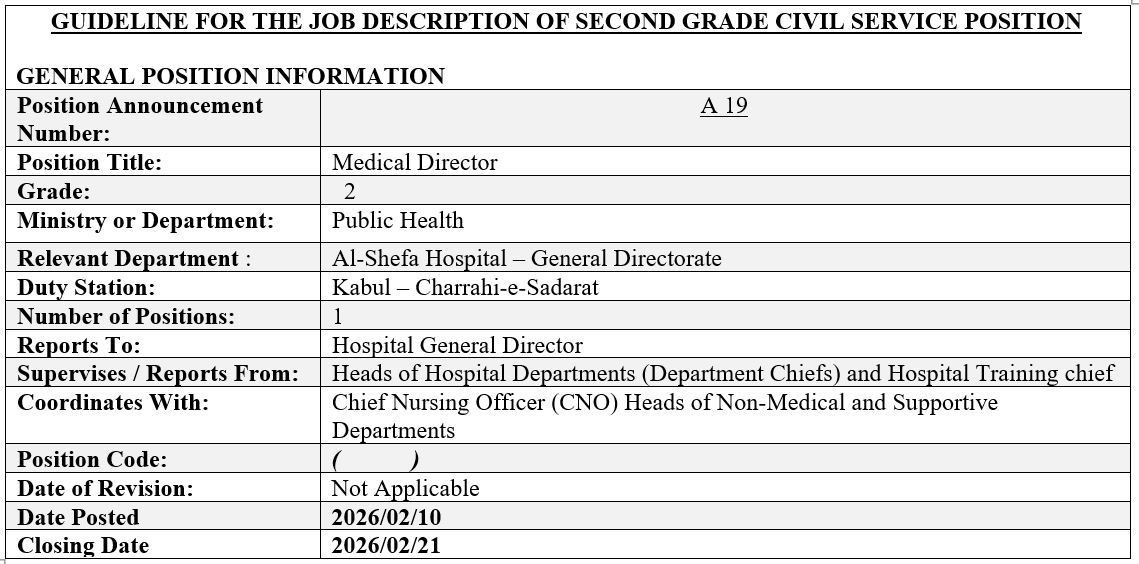
Publish Date
Closing Date
Job Purpose / Objective:
The Medical Director of the hospital supports the Hospital Director and oversees all medical activities to ensure that high-quality healthcare is provided to patients while effectively managing medical personnel, clinical services, and compliance with legal and regulatory standards of the Ministry of Public Health.
The Medical Director is also responsible for managing and developing high-quality, patient-centered supportive and ancillary services. To achieve these objectives, the Medical Director ensures financial performance aligns with the annual budget, aiming to enhance patient and staff satisfaction and advance service delivery standards.
Additionally, the Medical Director plays a key role as a senior member of the leadership team, contributing to the development and implementation of strategic plans, leadership, and collaboration across departments to ensure the hospital delivers not only excellent medical services but also prioritizes medical education and research while fully complying with all legal and regulatory requirements of the Ministry of Public Health.
..................................................................................................................................................................................................................................................................................................
Duties and Responsibilities:
Core Duties:
Clinical Operations Oversight:
- Deliver high-quality medical care within their specialized department.
- Supervise clinical services and healthcare delivery across all departments to ensure high standards of quality and patient safety.
- Serve as a professional role model and provide mentorship through interactions with clinical team members, patients, and their families.
- Manage the operations of hospital professional departments, including inpatient wards, medical records, staff, and medical and non-medical equipment.
- Oversee the implementation of continuous professional development (CPD) programs for clinical staff through lectures, educational media, and hands-on training.
- Actively participate in joint supportive supervision rounds according to established guidelines and checklists, identify deficiencies, and develop and implement corrective action plans.
- Manage the hospital morning report (including department heads, specialist trainers, specialists, trainee doctors, and supportive unit staff) according to established protocols.
- Be responsible for implementing and evaluating standards, protocols, guidelines, and other operational procedures relevant to their area.
- Provide clinical leadership to department heads (outpatient, inpatient wards, operating rooms, and other units) by modeling clinical practice in accordance with hospital and Ministry of Public Health policies and procedures.
- Ensure effective use of medical resources and improve care quality through evidence-based medical practice.
- Ensure compliance with medical regulations, accreditation standards, and hospital policies.
Medical Leadership and Strategic Development:
- Develop the hospital’s professional operational plan (clinical services, quality improvement, capacity building, and ensuring the availability of medicines and medical equipment) and ensure its implementation.
- Serve as a member of the senior leadership team and collaborate with the Hospital CEO and Board in defining the hospital’s strategic directions.
- Provide visionary leadership in the development and implementation of the hospital’s medical service strategy.
- Ensure alignment of hospital medical activities with the overall institutional objectives.
- Actively participate in strategic, operational, financial, and procurement planning, as well as decision-making regarding hospital expansion, new services, and investment projects, ensuring the implementation and achievement of operational plans.
- Prepare monthly, quarterly, and annual work plans in accordance with the general plan to achieve the hospital’s set objectives.
- Organize and lead medical review meetings with other medical staff.
- Work closely with senior leadership to align hospital-wide initiatives with patient care objectives.
- Identify and assign duties to all international medical personnel arriving at the hospital for short- or long-term assignments.
- Responsible for the accurate, timely, and complete collection, analysis, and reporting of health management information system (HMIS) data, including medical errors from various hospital departments, and submit reports monthly and semi-annually to the Hospital Director and Ministry of Public Health.
- Organize and manage quality improvement committees, HMIS reviews, mortality reviews, and DTC committees to support decision-making and ensure effective implementation aimed at improving healthcare service delivery.
- Oversee and support the hospital-wide cleaning process (patient rooms, corridors, bathrooms, clinics, entrances, medical and non-medical equipment) according to guidelines.
- Prepare and organize monthly 24-hour duty rosters for the hospital’s medical and professional departments in coordination with the hospital management team and department heads.
- Submit monthly, quarterly, annual, and as-needed reports on activities and achievements to the Hospital Director.
- Perform any other duties assigned by the Hospital Director in accordance with laws, regulations, and Ministry objectives.
Medical Education & Teaching:
- Support the development and delivery of educational programs for trainees, medical students, and clinical staff.
- Promote a culture of continuous learning, mentorship, and professional development within the medical team.
- Collaborate with the Education Program Coordinator and academic institutions to support the development and enhancement of the curriculum for trainees and professional medical staff.
- Ensure the organization of workshops, conferences, and educational programs to strengthen and enhance the capacity of the hospital’s professional staff.
Quality and Patient Safety:
- Lead programs and initiatives related to patient safety and quality improvement across all hospital departments.
- Review and monitor clinical outcomes and lead efforts to enhance the quality of care through patient safety programs, clinical audits, and the development of protocols.
- Supervise the implementation of best practices and clinical guidelines in all departments.
Medical Staff Management:
- Direct supervision of the recruitment, training, and performance evaluation of medical staff.
- Development of policies and protocols for performance management and oversight of medical staff.
- Promote effective communication and collaboration among doctors, clinical staff, and hospital management.
- Ensure appropriate certification and recognition for medical staff.
Collaboration with Hospital Leadership and Administration:
- Demonstrate strong interpersonal and communication skills to collaborate effectively with hospital leadership, staff, and external stakeholders.
- Serve as a key member of the hospital’s senior leadership team, working closely with administrative, nursing, and supportive clinical departments.
- Represent medical staff in executive meetings and contribute to operational decision-making within the hospital.
- Provide insights and recommendations regarding hospital budgeting, resource allocation, and strategic investments in medical infrastructure.
Regulatory Compliance &Accreditation:
- Ensure adherence to all applicable laws and regulations governing the provision of healthcare services within the hospital.
- Lead hospital-wide efforts to maintain and uphold accreditation status and meet all regulatory and legal requirements.
- Prepare for and oversee inspections or audits of medical activities, ensuring that the hospital consistently meets high standards during supervisory visits and regulatory inspections.
Research & Innovation:
- Promote a culture of research by encouraging medical staff to participate in clinical trials, research projects, and innovative initiatives.
- Collaborate with research teams to ensure medical research aligns with hospital objectives and ethical standards.
- Oversee the integration of new technologies and innovative activities to improve patient care outcomes.
Budget & Financial Oversight:
- Manage the medical department’s budget and ensure the effective allocation of resources and operational expenditures of the hospital.
- Review and reassess financial reports of clinical departments and propose strategies to control costs while maintaining the quality of patient care.
Community & Stakeholder Engagement:
- Serve as the hospital’s representative in community health initiatives and establish strong relationships with healthcare professionals, organizations, and external stakeholders.
- Participate in public health programs and initiatives, and contribute to the development of health policies as needed.
………..........................................................................................................................................................................................................................................................................................
Employment Requirements / Qualifications:
- Must be a citizen of Afghanistan.
- Age must be between 35 and 60 years.
- Educational Qualifications:
- MD/or equivalent medical degree from a recognized and accredited medical university approved by the Ministry of Higher Education.
- Holding a diploma or master’s degree in hospital management (EPGDHA, MHA), approved by the Ministry of Higher Education and relevant authorities, is considered an advantage.
- Post- graduated specialization or fellowship in relevant clinical areas is preferred.
4. Work Experience:
- Minimum of 5–7 years of clinical experience in a hospital setting, with at least 3–5 years in a hospital leadership role.
- Experience in multidisciplinary clinical environments, preferably in tertiary hospitals or academic/teaching medical centers.
- Proven track record in managing medical staff and performing administrative roles.
- Demonstrated experience in leading quality improvement initiatives and achieving measurable clinical outcomes.
5. Licenses/Certifications:
- Valid medical practice license from the Medical Council.
6. Skills and Competencies:
- Proficiency in one of the national languages (Pashto or Dari).
- Computer literacy in relevant applications and software.
- Exceptional leadership, communication, and interpersonal skills.
- Proficiency in English (writing, speaking, and reading).
- Strong knowledge of hospital administration, healthcare regulations, and clinical operations.
- Familiarity with healthcare technology, data analysis, and decision-support systems.
- Strategic thinking and sound understanding of financial management and hospital budgeting.
- Commitment to innovation, academic excellence, and patient-centered care.
- Ability to participate in long-term strategic planning and effectively achieve departmental objectives.
- Integrity and professionalism in all interactions with patients, their families, and hospital staff.
- Ability to accept responsibility for mistakes and work effectively in a multidisciplinary team.
- Capacity to lead teams with a clear and inspiring vision. (Leadership & Visionary Thinking)
- Ability to design strategies and solve complex problems effectively. (Strategic Planning & Problem Solving)
- Expertise in clinical practice and quality management. (Clinical Expertise & Quality Management)
- Ability to foster collaboration and team spirit across departments. (Collaboration & Team Building)
- Skills in conflict resolution and timely decision-making. (Conflict Resolution & Decision Making)
- Effective communication and stakeholder engagement with internal and external parties. (Communication & Stakeholder Engagement)
- Ability to develop and conduct medical research and promote innovation to improve patient care and health services. (Research & Innovation in Medicine)
7. Key Performance Indicators (KPIs):
- Quality of Clinical Care: Percentage adherence to clinical protocols and standards, reduction in patient incidents and complaints.
- Leadership & Staff Performance: Staff satisfaction, evaluation of clinical team performance, and professional development.
- Strategic & Operational Goals Achievement: Achievement of established clinical and operational objectives.
- Research & Innovation Output: Number of research projects, publications, and implementation of innovations and new technologies.
- Financial & Resource Management: Effective budget management, resource allocation, procurement of necessary resources, and cost control.
Submission Guideline
Electronic applications will be sent to: sub e-mail which corresponds if any of following 2 items
is missing, your application will be considered as ineligible/incomplete.
1. In your emails please specify the title of the position as well as vacancy number for electronic submissions .
2. Please submit your updated CV along with copies of your academic credentials and documents supporting your professional experience.
Kindly ensure that your résumé clearly indicates the exact dates and duration of each position held, as well as your precise date of graduation (month, and year).
If you are shortlisted and invited for written test/interview you will be required to present the original, the following:
• Electronic applications will be sent to: sub e-mail
• The Contact Person at Human Resources is:, HR Officer, MoPH-GD HR. Phone number: 0093- (0)-202312422
Note:
- The salary and benefit is paid according to the organization special salary scale
- The salary and benefit is paid according to the organization special salary scale
Only shortlisted candidates will be invited to written test/interview and subsequent
• No CVs will be accepted after the closing date.
Submission Email