Chief of Urology and Kidney Transplant Department!
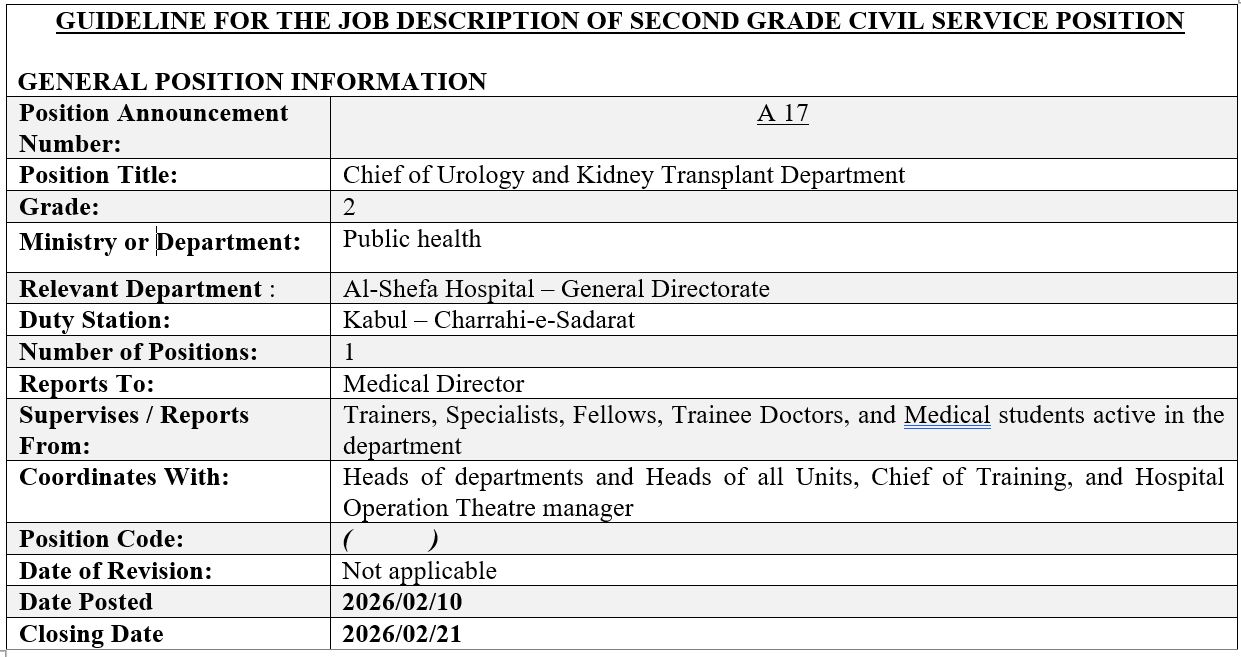
Publish Date
Closing Date
Purpose of the Position
The Head of the Urology and Kidney Transplant Department of the hospital will provide strategic leadership and operational oversight of the hospital’s urology and kidney transplant services. This responsibility includes managing the clinical, educational, research, and administrative activities of the department to ensure the highest standards of patient care, medical education, and scientific research. The Head of the Urology and Kidney Transplant Department is responsible for aligning departmental goals and operations with the hospital’s overall mission, in close coordination with other department heads, the hospital management team, and healthcare staff. ......................................................................................................................................................................
Key Duties and Responsibilities:
Core Duties:
Clinical Leadership:
- Lead, supervise, and provide advanced diagnostic and therapeutic urology and kidney transplant services for patients in outpatient, inpatient, and intensive care settings.
- Lead a multidisciplinary team to deliver high-standard, exceptional care to kidney transplant patients, from pre-transplant evaluations to post-transplant management.
- Lead, supervise, and provide advanced kidney transplant diagnostic and therapeutic services for patients in outpatient, inpatient, and intensive care settings.
- Oversee the selection and management of kidney transplant donors and recipients, ensuring full compliance with ethical principles, clinical criteria, and legal regulations.
- Supervise the management of urology and kidney transplant emergencies and critical care interventions.
- Develop, implement, and maintain protocols, guidelines, and evidence-based best practices in urology and kidney transplantation.
- Evaluate the performance of specialist trainers, trainees, and surgical teams in coordination with the hospital’s human resources management.
- Manage complex and challenging urology and kidney transplant cases and provide consultation with other hospital departments.
- Ensure that multidisciplinary teams provide coordinated, comprehensive, and holistic patient care.
- Keep departmental professional staff updated on the latest advancements in urology and kidney transplantation and utilize modern techniques and technologies to improve patient care.
- Supervise and collaborate closely with fellows, trainees, nurses, and other healthcare staff to ensure high-quality healthcare delivery.
- Ensure effective patient flow, timely execution of medical interventions, and strict adherence to hospital protocols, standards, and quality requirements.
- Regularly review departmental performance indicators, such as patient outcomes and procedural success rates, and implement corrective measures when necessary.
- Perform on-call duties as Chief of Service and, if required, as Second Call according to the duty roster established by the department and hospital administration.
- Ensure timely provision of medical and professional consultations.
Education and Training (Capacity Building):
- Lead and supervise educational programs, including high-quality theoretical and practical training in patient care, urology, and kidney transplantation methods.
- Manage kidney transplant surgical training programs for trainees and fellows, ensuring the provision of high-quality practical and theoretical education in both clinical and academic settings.
- Ensure that the team is up-to-date with the latest advancements in clinical urology and kidney transplantation care through Continuing Medical Education (CME) programs.
- Encourage collaboration and conduct research in the field of urology, kidney transplantation, and related specialties.
- Facilitate clinical teaching, guidance, and mentoring to promote a culture of learning, professional growth, and capacity development within the department.
- Develop and deliver specialized educational programs, workshops, and lectures for urology and kidney transplantation department staff as well as other hospital personnel.
- Organize and actively participate in clinical rounds, case discussions, and the presentation of specialized medical seminars.
- Ensure that the department’s educational programs align with the hospital’s academic and training objectives.
- Design, identify, support, and implement scientific and clinical/experimental research topics based on clinical needs and research priorities of the hospital and the Ministry of Public Health within the respective department.
- Mobilize funding for research projects and ensure compliance with national and international ethical standards throughout all stages of research implementation.
- Encourage department members to publish articles and findings from clinical and experimental research in reputable national, regional, and international journals and platforms, and foster collaboration with academic institutions, hospitals, universities, and research centers domestically and internationally.
- Organize weekly scientific meetings, deliver conferences, and conduct training seminars on research methodologies to promote and enhance the scientific and research skills of departmental staff.
- Continuously monitor, analyze, and evaluate the quality of activities, outcomes, and achievements of scientific and research projects, and provide recommendations to improve these processes within the respective department.
Leadership and Administrative Responsibilities:
- Responsible for managing all professional and administrative operations, including oversight of recruitment, staff appointments, and performance evaluation of all medical personnel within the department.
- Provide leadership, mentorship, and professional development opportunities for all department staff, including faculty, trainees, and fellows.
- Develop and implement monthly, quarterly, annual, and strategic work plans for the department in alignment with the hospital’s overall operational plan and the Ministry of Public Health strategies to improve departmental operations, clinical outcomes, and patient satisfaction.
- Manage the department’s budget and resources to ensure adequate allocation and cost-effectiveness.
- Evaluate departmental performance and take corrective actions as necessary to achieve quality, safety, accreditation standards, and patient satisfaction.
- Arrange and maintain 24-hour duty rosters for departmental professional staff, including trainers, specialists, trainee doctors, and fellows.
- Include leave days and public holidays according to scheduled work shifts.
- Actively participate in morning reports to ensure proper delivery of services over the past 24 hours in the department.
- Ensure the presence of all departmental personnel, including adherence to their assigned duties during duty hours.
- Collaborate with the hospital management team regarding decision implementation, personnel allocation, and workflow management.
- Responsible for implementing guidelines, standards, professional procedures, and diagnostic/treatment protocols to enhance service quality within the department.
- Be prepared for and participate in hospital emergency events to ensure timely and efficient delivery of urology and kidney transplant services to those in need.
- Participate in hospital-wide clinical rounds, DTC committee meetings, mortality review committees, quality improvement initiatives, HMIS committees, and other sessions as convened by the hospital administration.
- Supervise, manage, and, when necessary, implement disciplinary actions among department members.
- Provide monthly, quarterly, annual, and ad-hoc reports on departmental activities and achievements to the Hospital Chief Medical Officer.
- Perform other duties assigned by the hospital administration in accordance with laws, regulations, and the objectives of the hospital and Ministry of Public Health.
Quality Assurance and Patient Safety:
- Promote a culture f patient safety and enhance the quality of services within the Urology and Kidney Transplant Department.
- Ensure full compliance o
- with health regulations, clinical quality standards, and patient safety protocols in accordance with Ministry of Public Health guidelines and accreditation requirements in all departmental activities.
- Lead Continuous Quality Improvement (CQI) programs and monitor departmental performance based on pre-established indicators and standards.
- Collaborate with the hospital administration and quality improvement committees to address issues related to patient safety, clinical care, and hospital-acquired infections (HAI).
- Conduct regular inspections or audits of surgical outcomes, kidney transplant procedures, and implement corrective actions as necessary.
- Lead Morbidity & Mortality (M&M) review sessions to continuously improve departmental performance.
- Maintain accreditation standards and ensure full readiness for external evaluations and formal inspections.
Collaboration and Communication:
- Maintain close collaboration with other hospitals, departmental heads, senior leadership, and supporting units to ensure uninterrupted, integrated, and coordinated patient care across the hospital.
- Actively participate in hospital-wide committees and provide expert input in strategic planning, operational goals, and the development of key hospital policies.
- Foster a collaborative, supportive, and team-oriented work environment among faculty, staff, and trainees within the department.
- Ensure effective, transparent, and reciprocal communication at all levels of the department to cultivate a culture of trust, accountability, and openness.
Patient and Family Relations:
- Promote patient-centered care by providing clear and comprehensive information to patients and their families, and actively involving them in decisions regarding the treatment of their patients.
- Address patient and family complaints, concerns, and issues promptly and effectively, particularly those related to the services of the Urology and Kidney Transplant Department.
- Strive to enhance the hospital’s reputation as a provider of high-quality, compassionate care within the community.
........................................................................................................................................................................................
Employment Requirements / Eligibility Criteria:
- Citizenship: Must be a citizen of Afghanistan.
- Age: Must be between 35 and 60 years of age.
- Educational Qualifications:
- Doctor of Medicine (MD) or equivalent from a recognized and accredited national or international university, with a specialization in Urology Surgery and/or Kidney Transplantation, approved by the Ministry of Higher Education.
- Fellowship training in Nephrology and Kidney Transplant Surgery is preferred.
- Work Experience:
- Minimum of 5–7 years of clinical experience in Urology and at least 3–5 years of work in a Kidney Transplant Department, including leadership or supervisory roles.
- Proven expertise in all areas of urology services and operations, particularly endourology and trauma procedures.
- Documented track record of successful kidney transplant surgeries and procedures.
- Research experience, including clinical trials and participation in relevant scientific publications, is considered an important advantage.
- Extensive teaching experience for medical students, surgical trainees, and fellows, with demonstrated success in academic leadership.
- Licensing:
- Must hold a valid medical practice license issued by the Medical Council.
- Skills and Competencies:
- Proficiency in one of the national languages (Dari or Pashto).
- Computer skills relevant to the job responsibilities.
- High-level clinical expertise in kidney transplantation, including pre-transplant evaluation, surgery, and post-transplant care.
- Ability to effectively manage emergency cases and be available for on-call or standby duties as needed.
- Capacity to teach, guide, and supervise trainees in the Postgraduate Medical Education (PGME) program.
- Excellent leadership and management skills, with the ability to lead diverse and multidisciplinary teams.
- Strong interpersonal communication and mentorship skills.
- Proficiency in English (reading, writing, and speaking).
- Strategic planning skills with the ability to effectively achieve departmental goals.
- Expertise and experience in patient safety, quality improvement, and clinical auditing processes.
- Commitment to innovation, academic excellence, and patient-centered care.
- Ability to remain calm, composed, and make rational decisions in critical situations.
- Integrity and professional conduct in interactions with patients, their families, and hospital staff.
- Ability to accept responsibility, acknowledge mistakes, and work effectively in multidisciplinary teams.
- Key Performance Indicators (KPIs):
- Treatment outcomes and high patient satisfaction.
- Volume and success rates of urology and kidney transplant surgeries, including post-operative complications.
- Scientific and research achievements, including publications, securing funding, and innovations.
- Effectiveness of training programs and evaluation of trainees’ and fellows’ performance.
- Compliance with quality standards, patient safety, and accreditation requirements.
Submission Guideline
Electronic applications will be sent to: sub e-mail which corresponds if any of following 2 items
is missing, your application will be considered as ineligible/incomplete.
1. In your emails please specify the title of the position as well as vacancy number for electronic submissions .
2. Please submit your updated CV along with copies of your academic credentials and documents supporting your professional experience.
Kindly ensure that your résumé clearly indicates the exact dates and duration of each position held, as well as your precise date of graduation (month, and year).
If you are shortlisted and invited for written test/interview you will be required to present the original, the following:
• Electronic applications will be sent to: sub e-mail
• The Contact Person at Human Resources is:, HR Officer, MoPH-GD HR. Phone number: 0093- (0)-202312422
Note:
- The salary and benefit is paid according to the organization special salary scale
Only shortlisted candidates will be invited to written test/interview and subsequent
• No CVs will be accepted after the closing date.
Submission Email