Chief of Imaging Services Department!
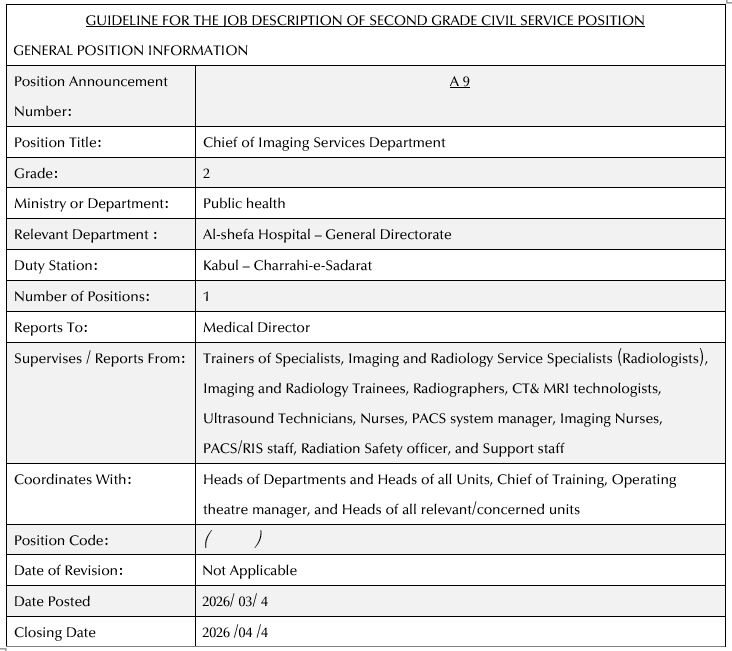
Publish Date
Closing Date
:Purpose of the Position
The Head of the Imaging Services Department is responsible for the strategic leadership and the clinical, research, administrative, and academic management of the Imaging Services Department. This responsibility ensures the delivery of high-quality diagnostic and imaging services, and the safety of staff and patients, based on scientific evidence and in compliance with accreditation standards, hospital policies, and national health regulations.
The position holder oversees clinical operations, management of imaging services staff, and the provision of accurate, timely, evidence-based reporting in accordance with imaging accreditation standards. The role also ensures compliance with radiation safety requirements and supervises the academic training of trainees and technologists in support of subspecialty services and residency/fellowship training programs.
The Head of the Imaging Services Department will work closely with other Department Heads, senior management, and medical staff to ensure that departmental activities are fully aligned with the hospital’s mission, vision, and overall objectives.
.....................................................................................
Key Duties and Responsibilities:
Core Duties:
Clinical and Diagnostic Services Leadership:
- Lead, manage, and supervise the daily operations of the Imaging Services Department, including plain radiography (X-ray), ultrasound and Doppler, CT scan, MRI, mammography, fluoroscopy, interventional radiology and imaging services, nuclear medicine, Cath Lab imaging support services, portable and bedside imaging, PACS and RIS, and radiation safety and control, ensuring that all imaging services are delivered efficiently and to high-quality standards.
- Ensure the preparation of accurate, timely, and safe imaging reports based on clinical indications, diagnostic standards, and evidence-based practices.
- Strengthen close collaboration with multidisciplinary clinical departments and provide imaging consultations to other departments to support accurate diagnosis.
- Develop, review, update, and implement imaging protocols, clinical referral criteria, and reporting standards to ensure safe, effective, and ethical imaging services within the Imaging and Radiology Department.
- Supervise and ensure the quality of diagnostic and interventional procedures, and ensure compliance with national and international standards, regulations, and safety protocols by radiologists, technologists, technicians, and support staff in delivering services to patients.
- Manage complex and challenging cases, communicate critical findings, and provide expert consultations to support diagnostic and therapeutic decision-making.
- Oversee the management of emergency imaging cases, trauma cases, oncology, cardiology, neurosurgery, and critical care interventions.
- Supervise and collaborate with fellows, trainees, nurses, and other healthcare staff of the Imaging Services Department to ensure high-quality patient care.
- Ensure effective communication with referring physicians, maintain efficient patient flow, and ensure timely interventions and procedures in accordance with hospital protocols and quality standards.
- Keep departmental staff up to date with recent advances in imaging and radiology, and promote innovation and the adoption of new techniques and technologies to improve patient care.
- Perform duties as the on-call Head (first call) and, when required, second call, in accordance with the approved departmental and hospital duty roster.
Education and Training (Capacity Building):
- Lead and supervise fellowship and residency trainees, technologists, and relevant staff of the Imaging Services Department, ensuring that trainees receive high-quality theoretical and practical clinical training in imaging, radiology, and imaging techniques.
- Organize and lead Continuing Medical Education (CME) programs, case discussions, imaging rounds, and journal club sessions.
- Participate in and collaborate with academic institutions in the development and evaluation of curricula for training and subspecialty programs.
- Support and encourage research activities, scientific publications, and participation in professional conferences.
- Support the integration of imaging services into interdisciplinary educational and research programs in collaboration with surgical, oncology, and cardiology departments.
- Facilitate clinical training and mentorship, and promote a culture of learning and professional development.
- Develop and deliver training programs, workshops, seminars, and lectures for departmental staff and hospital personnel.
- Ensure that departmental educational programs are aligned with the hospital’s academic and educational objectives.
Research and Innovation:
- Promote a culture of research within the department and encourage faculty members and trainees to participate in clinical and basic science research projects in imaging and clinical imaging services.
- Design and lead scientific research initiatives aimed at improving imaging techniques, clinical outcomes, and the delivery of healthcare services.
- Strengthen collaboration with academic institutions and other research organizations to support innovative imaging approaches and the development of new diagnostic and therapeutic techniques.
- Ensure the publication of high-quality research findings in reputable peer-reviewed journals and their presentation at relevant scientific conferences.
- Promote interdisciplinary research and collaboration with other hospital departments, universities, and research institutions.
- Encourage the dissemination of research findings and facilitate collaboration with national and international institutions.
- Secure financial resources for research projects and ensure compliance with ethical standards.
Leadership and Administrative Responsibilities:
- Supervise the recruitment, retention, and performance management of staff; organize shifts and duty rosters; and allocate duties and workloads within the department.
- Ensure the availability, proper functioning, and optimal utilization of imaging and radiology equipment and related consumables.
- Oversee PACS/RIS systems and enhance the efficiency of digital workflow processes.
- Develop policies, standard operating procedures (SOPs), clinical pathways, and accreditation compliance documentation.
- Manage the departmental budget and procurement plans, ensuring efficient use of resources and appropriate allocation of funds for staffing, equipment, and infrastructure.
- Facilitate and organize work schedules to ensure 24-hour coverage of imaging and radiology services, with adequate accessibility and timely responsiveness for emergency, critical care, and elective procedures.
- Ensure that departmental equipment and technologies are regularly upgraded, maintained, and serviced in compliance with safety standards.
- Lead the department’s participation in hospital committees, including those focused on clinical governance, quality improvement, and patient safety.
- Provide leadership, mentorship, and professional development opportunities for all imaging and radiology department staff, including faculty members, trainees, and fellows.
- Develop and implement monthly, quarterly, annual, and strategic departmental work plans in alignment with the hospital’s overall operational plan and the Ministry of Public Health strategies to improve departmental performance, clinical outcomes, and patient satisfaction.
- Collaborate with hospital leadership to ensure compliance with laws, accreditation standards, and quality indicators.
- Evaluate departmental performance and implement corrective actions as needed to meet quality, safety, and patient satisfaction standards.
- Review and analyze departmental expenditures to ensure efficient use of resources and cost-effectiveness while maintaining a high standard of service quality.
- Ensure that the department complies with all requirements related to billing and coding of imaging services.
- Supervise procurement, maintenance, and servicing of equipment, and ensure compliance with regulations governing medical imaging technologies.
- Ensure accuracy, timeliness, and confidentiality of all imaging results provided by the department.
- Actively participate in the hospital’s morning general report to ensure continuity and review of imaging services delivered during the previous 24 hours.
- Supervise and enforce discipline among departmental staff.
- Prepare and submit monthly, quarterly, annual, and ad hoc reports on departmental activities and achievements to the Hospital Medical Director.
- Perform any other duties assigned by hospital leadership in accordance with applicable laws, regulations, and the objectives of the hospital and the Ministry of Public Health.
Quality Assurance and Patient Safety:
- Ensure compliance with accreditation standards, national radiation safety regulations, and relevant guidelines.
- Implement quality assurance and quality control (QA/QC) programs for all imaging modalities and procedures.
- Monitor adverse events, radiation incidents, and performance outcomes against established quality indicators.
- Promote infection prevention practices and ensure the safe use and administration of contrast media.
- Monitor departmental performance indicators such as report turnaround time, repeat imaging rates, quality of imaging results, patient satisfaction, incident reports, and radiation events, and ensure corrective actions are taken when necessary.
- Ensure patient safety through safe practices in the use and administration of contrast media, radiation dose control, adherence to the ALARA (As Low As Reasonably Achievable) principle, and infection prevention measures.
- Ensure that all imaging services fully comply with health regulations, safety standards, and accreditation requirements.
- Maintain accreditation standards and ensure preparedness for external assessments and evaluations.
Collaboration and Communication:
- Uphold professional ethical standards and ensure patient confidentiality in accordance with hospital regulations.
- Ensure close collaboration with clinical departments such as surgery, oncology, cardiovascular services, and emergency care to ensure timely and effective sharing of imaging results with treatment teams for informed clinical decision-making.
- Provide specialized imaging consultations to multidisciplinary teams to support the clinical management of complex and challenging cases.
- Establish and strengthen strong working relationships with hospital management, clinical teams, departmental staff, and administrative teams to ensure alignment of imaging services with the hospital’s strategic goals and plans.
- Work closely with other department heads, senior leadership, and support services to ensure uninterrupted patient care and integrated services across the hospital.
- Participate in hospital-wide committees and contribute opinions and recommendations related to strategic planning, operational objectives, and policy development.
- Foster a collaborative, supportive, and team-oriented working environment among faculty members, staff, and trainees within the department.
- Ensure open and effective communication at all levels of the department to promote a culture of transparency and trust.
Patient and Family Relations:
- Promote patient-centered care by informing patients about imaging-related decision-making processes and appropriate preparation for recommended imaging procedures.
- Address patient and family complaints, concerns, and issues related to imaging services promptly and effectively.
- Contribute to enhancing the hospital’s reputation as a provider of high-quality, compassionate diagnostic imaging services within the community.
....................................................................................................................................................................................... Employment Requirements / Eligibility Criteria
- Citizenship: Must be an Afghan National.
- Age: Must be at least 35 years old and not older than 60 years.
- Educational Qualifications:
- Medical Degree (MD) or its equivalent from a recognized medical university, along with a specialization certificate in Diagnostic Imaging Services/Radiology duly approved by the Ministry of Higher Education.
- Subspecialty qualification or proven experience in MRI or Interventional Radiology will be considered an added advantage.
- Holding a recognized Board Certification and/or completion of a Fellowship in one of the subspecialties of Imaging Services such as Neuroradiology, Musculoskeletal Imaging, or Interventional Radiology, along with training in JCIA/QMS, is preferred.
- Valid Radiation Safety Certificate is mandatory.
4. Work Experience:
- A minimum of 5–7 years of clinical experience in Imaging and Radiology Services, including experience in advanced imaging techniques and interventional procedures.
- At least 3 years of experience in a leadership, managerial, or consultant role within a hospital or academic medical institution.
- Research experience, including involvement in clinical trials and participation in scientific publications, is highly desirable.
- Proven experience in mentoring and supervising trainees and fellows, and overseeing educational programs.
- Demonstrated participation in clinical research and publication of scientific articles.
5. Professional License:
- Possession of a valid medical practice license issued by the Medical Council.
6. Required Skills and Competencies:
- Proficiency in at least one of the national official languages (Pashto or Dari).
- Adequate computer skills relevant to the position.
- Strong leadership and communication skills, with proficiency in PACS/RIS systems, and preferably familiarity with Interventional Radiology Services.
- Ability to make sound clinical decisions with high diagnostic accuracy.
- Thorough knowledge of accreditation standards and clinical management systems.
- Strong ability in teaching, mentoring, and participation in academic or scientific activities.
- Comprehensive knowledge of imaging practices and procedures, medical ethics, clinical research, and academic medicine.
- Excellent interpersonal and communication skills, with the ability to work collaboratively with clinical staff, administrative teams, and external stakeholders.
- Advanced clinical expertise in diagnostic imaging, advanced imaging techniques, and interventional procedures.
- Ability to effectively lead and manage departmental budgets and resources.
- In-depth knowledge of medical imaging technologies, radiation safety protocols, and regulatory requirements.
- Strong commitment to patient-centered care, education, and continuous quality improvement.
- Ability to manage emergency situations effectively and availability for on-call duties when required.
- Proficiency in English language skills (reading, writing, and speaking).
- Ability to actively participate in strategic planning and effective implementation of departmental goals.
- Adherence to professional ethics and a strong commitment to innovation, academic excellence, and patient-focused care.
- Demonstrated integrity and professionalism in all interactions with patients, their families, and hospital staff.
- Ability to acknowledge mistakes, take responsibility, and work effectively within a multidisciplinary team.
7. Working Conditions:
- Full-time position within a hospital environment.
- Performance of on-call duties in accordance with the approved duty roster.
- Work in radiation-controlled environments with strict adherence to mandatory radiation safety principles.
8. Key Performance Indicators (KPIs):
- Departmental performance indicators, including turnaround time, timeliness and quality of imaging reports, and patient satisfaction.
- Success in recruitment, hiring, and retention of skilled and professional imaging and radiology staff.
- Increased participation in impactful research and publication of scientific articles.
- Improved patient treatment outcomes through the use of advanced imaging techniques.
- Continuous improvement of departmental processes through quality assurance and safety programs.
- Level of compliance with accreditation standards and scores achieved during evaluations.
- Operational uptime of equipment and efficiency of workflow processes.
- Progress and performance evaluation of trainees within educational programs.
Submission Guideline
Electronic applications will be sent to: sub e-mail which corresponds if any of following 2 items
is missing, your application will be considered as ineligible/incomplete.
1. In your emails please specify the title of the position as well as vacancy number for electronic submissions and .
2. Please submit your updated CV along with copies of your academic credentials and documents supporting your professional experience.
Kindly ensure that your résumé clearly indicates the exact dates and duration of each position held, as well as your precise date of graduation (month, and year).
If you are shortlisted and invited for written test/interview you will be required to present the original, the following:
• Electronic applications will be sent to: sub e-mail
• The Contact Person at Human Resources is:, HR Officer, MoPH-GD HR. Phone number: 0093- (0)-202312422
Note:
- The salary and benefit is paid according to the organization special salary scale
Only shortlisted candidates will be invited to written test/interview and subsequent
• No CVs will be accepted after the closing date.
قابل ذکره است متخصصین محترم که عملآ در شفاخانه های دولتی اجرای وظیفه می نمایند بنابر ایجاد سکته گی در امورات قبلی شان و جلوگری از متضرر شدن سکتور صحی دولتی در بست های شفاخانه الشفا قابل شارت لست نمی باشند.
Submission Email